
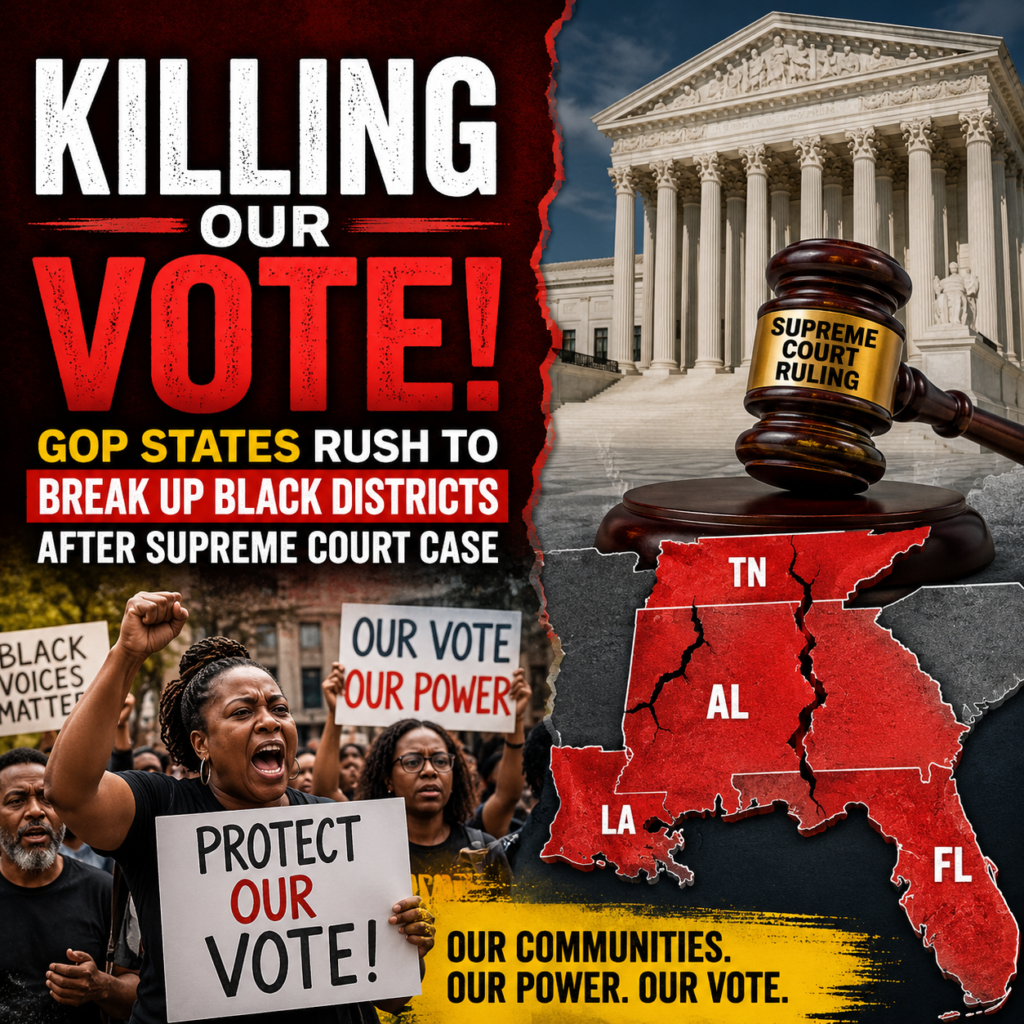
GOP States Move to Redraw Black Congressional Districts After Supreme Court Ruling
Republican-led states across the South are moving quickly to redraw congressional districts after a U.S. Supreme Court ruling weakened a major part of the federal Voting Rights Act, triggering anger from Democrats, civil rights groups, and Black voters who say the changes could reduce minority political power before the 2026 midterm elections.
The Supreme Court’s 6-3 decision in Louisiana vs. Callais, issued on April 29, allowed states to split apart majority-minority congressional districts when lawmakers argue the changes are based on political goals rather than race. The ruling has already sparked rapid legislative action in Alabama, Louisiana, Florida, Tennessee, and other states.
Civil Rights Leaders Condemn the Decision
NAACP President and CEO Derrick Johnson strongly criticized the ruling, comparing it to some of the most damaging Supreme Court decisions in American history. He said the decision could be remembered alongside cases such as Dred Scott and Plessy v. Ferguson because of its potential impact on Black political representation.
Civil rights advocates argue that the decision weakens Section 2 of the 1965 Voting Rights Act, which has long protected minority voters from district maps that dilute their ability to elect candidates of their choice.
Southern States Begin Redistricting Push
In Alabama, lawmakers are preparing for a possible special primary election using a congressional map that had previously been blocked by federal courts. The move could put at least one of the state’s two Black U.S. House members at risk.
In Louisiana, Gov. Jeff Landry suspended the state’s U.S. House primary elections, setting aside about 42,000 votes that had already been cast. Republican lawmakers are expected to advance a new congressional map that could threaten one of the state’s two Black House members.
Florida Gov. Ron DeSantis signed a new map into law that could give Republicans as many as four additional U.S. House seats. The map has already drawn legal challenges.
Tennessee Republicans are also moving to redraw the Memphis-area district represented by Democratic U.S. Rep. Steve Cohen. The district is currently Tennessee’s only majority-Black congressional district.
Black Voters and Democrats Say Representation Is Under Attack
Democrats and Black residents say the redistricting efforts threaten decades of political progress in the South. Many argue the new maps could break apart communities that have historically relied on the Voting Rights Act to protect their political voice.
At a hearing in Alabama, Barbour County resident Eliza Jane Franklin warned lawmakers that the new maps would weaken Black voting power.
“We refuse to let you kill us by killing our vote,” Franklin said.
Voting rights advocates say the issue is not only about party politics. They argue that the new maps could make it harder for Black voters to elect candidates who represent their communities and concerns.
Republicans Defend the New Maps
Republican leaders say the Supreme Court ruling supports a color-blind approach to redistricting. They argue that districts should not be drawn primarily based on race.
Tennessee House Speaker Cameron Sexton said the Supreme Court had made clear that redistricting should be “color-blind” as he announced a plan to divide the Memphis area among three congressional seats.
Other Republican officials have been more direct about the political stakes. GOP leaders in Alabama said lawmakers should give the state a chance to elect seven Republican U.S. representatives.
Midterm Elections Raise the Stakes
The redistricting push comes as Republicans seek to protect their narrow majority in the U.S. House ahead of the November 2026 midterm elections.
Democrats say the effort is designed to protect President Donald Trump from congressional oversight. If Democrats win control of the House, they could launch investigations into the Trump administration and block parts of his legislative agenda.
U.S. Rep. Steve Cohen said the redistricting push is about helping Trump avoid “hard questions and oversight hearings.”
Political experts say Republicans are trying to reduce their losses before what could be a difficult midterm election cycle.
Trump Encourages GOP Redistricting Efforts
Before the Supreme Court’s decision, Trump had already encouraged Republican-led states to redraw congressional maps for partisan advantage. Missouri, North Carolina, Ohio, and Texas have enacted more GOP-friendly maps, while Democratic-led states such as California and Virginia have responded with their own redistricting efforts.
Trump has also supported the idea of holding new elections under revised maps, even if voters have already cast ballots.
“If they have to vote twice, so be it,” Trump wrote on Truth Social.
Legal Challenges Begin
Democrats and voting rights groups are already challenging the new maps and election changes in court.
In Louisiana, Elias Law Group filed a petition arguing that Gov. Landry’s decision to suspend congressional primary elections is unlawful. The group said only the state legislature has the power to set election schedules.
“Governors do not get to cancel elections by executive fiat,” attorney Lali Madduri said in a statement.
Florida’s new congressional map is also facing court challenges, and more lawsuits are expected as other states move forward with redistricting plans.
Democrats Look for a Response
Some Democrats say the Supreme Court ruling shows the need for massive voter turnout in November. They argue that winning back the U.S. House would allow Democrats to pursue voting rights legislation.
U.S. Rep. James Clyburn said Democrats could try to pass new voting rights protections if they regain control of Congress. However, such legislation would still face major obstacles in the Senate and from the White House.
Other Democrats are calling for aggressive redistricting in blue states as a response to Republican efforts. House Minority Leader Hakeem Jeffries and Rep. Joseph Morelle have announced an initiative to encourage New York to redraw congressional districts before the 2028 election.
“This is just the beginning,” Jeffries said. “Across the nation, we will sue, we will redraw and we will win.”
Voting Rights Fight Expected to Continue
The Supreme Court’s decision has opened a new chapter in the national fight over redistricting, race, and political power.
Republicans say they are following the court’s guidance and drawing maps based on legal political considerations. Democrats and civil rights groups say the ruling permits states to weaken Black voting power at a critical moment.
With control of Congress at stake, the fight over Black districts is expected to remain one of the most important political and legal battles of the 2026 election cycle.